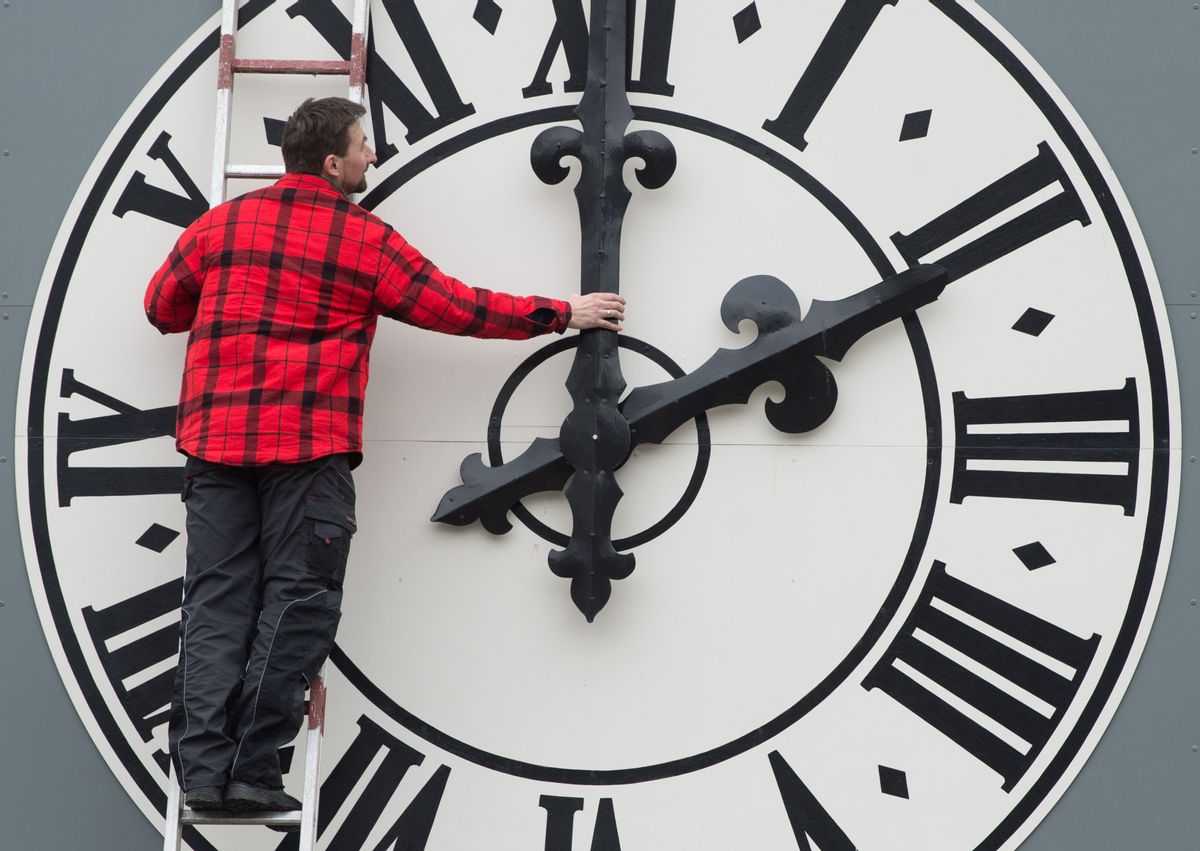
Prior to 2007, Daylight Saving Time (the second word is properly singular), or DST, began on the first Sunday in April: on that day, clocks were moved forward one hour in each time zone at 2:00 AM local time. In 2007, DST was shifted to begin earlier in the year, on the second Sunday in March (which in 2019 is March 10). Clocks are shifted back one hour in the fall: previously this return to "normal" time took place on the last Sunday in October, but since 2007 it has occurred on the first Sunday in November (which in 2019 is November 3).
The purpose of the shift is to transfer, in effect, an hour's worth of daylight from the early morning hours of the day, when only milkmen and chickens are awake to appreciate it, and use it to push back sunset until one hour later in the day. This arrangement is claimed to cut electricity usage in the evening and help reduce traffic accidents.
The concept of something much like Daylight Saving Time was referenced by Benjamin Franklin in a satirical 1784 essay titled "An Economical Project." After several European countries put daylight time into practice during World War I, the United States formally adopted it in 1918, but it proved unpopular and was discontinued in 1919. (The U.S. still had a large agrarian sector back then, and far fewer businesses stayed open into the later evening hours, so most people tended to rise and retire earlier than they do today, negating the practicality of shifting an hour's worth of daylight away from early morning.)
Although some cities and states opted to continue daylight time after 1919, it did not return on a national level until World War II, when it was referred to as "War Time" and observed year-round between 1942 and 1945. From 1945 through 1966 there was no federal law in effect to establish guidelines for daylight time, leaving states and municipalities to observe it how and when they chose, if at all.
By 1966 the different daylight time practices throughout the country were a source of difficulty for businesses that had to follow strict time schedules, such as television networks and airlines, so that year Congress passed the Uniform Time Act which specified that Daylight Saving Time begin on the last Sunday of April and end on the last Sunday of October. (States were still free to pass laws exempting themselves from the daylight time scheme.) After the "energy crisis" of 1973 precipitated by an Arab nations oil embargo against the U.S., President Nixon signed the Emergency Daylight Saving Time Conservation Act, which put the United States on Daylight Saving Time for the fifteen-month period between January 1974 and April 1975.
In 1986 federal law was amended to start Daylight Saving Time earlier in the year, the change now occurring at 2:00 AM on the first Sunday in April and ending at 2:00 AM on the last Sunday in October. Several states and territories of the U.S. (Arizona, Hawaii, Puerto Rico, the Virgin Islands, American Samoa, Guam, and the Northern Marianas Islands) do not observe daylight time.
In August 2005, the United States Congress passed the Energy Policy Act, which changed the dates of both the start and end of daylight saving time (DST). As of 2007, DST now starts three weeks earlier (2:00 AM on the second Sunday in March) and ends one week later (2:00 AM on the first Sunday in November) than before.
Some "surprising things about springing forward," as noted at AL.com:
Trains always adhere to their published schedules, so when it's time to "fall back" all Amtrak trains that are running on time stop in their tracks and wait an hour before resuming. When it's time to spring forward the trains automatically fall behind schedule at 2 a.m. but just have to do their best to make up the lost time.
*According to National Geographic Nielsen TV ratings during the hours impacted by the change to daylight saving time show large declines during the first week of DST--as much as 10 to 15 percent, even for popular shows.
*A study by Hardee's fast-food chain estimated that extending DST would increase sales by $880 a week per store.
*A 2015 report by the Brookings Institution found that, on the first day of daylight saving time, robbery rates fall by an average of 7 percent.
*[Newfoundland], Canada experimented with "double daylight saving time" in 1988 and set clocks ahead by two hours at one time in order to capitalize on the long hours of sunlight in the northern latitudes. DDST didn't stick, however.
*Even Antarctica, where there is no daylight in the Southern Hemisphere winter and a stretch of 24-hour daylight in the summer, observes DST at some of its research stations in order to keep the same time as suppliers in Chile or New Zealand.
Our DSTease page describes how a prankish newspaper editor put one over on the national press with his idea for a Daylight Saving Time "contest" in 1984.