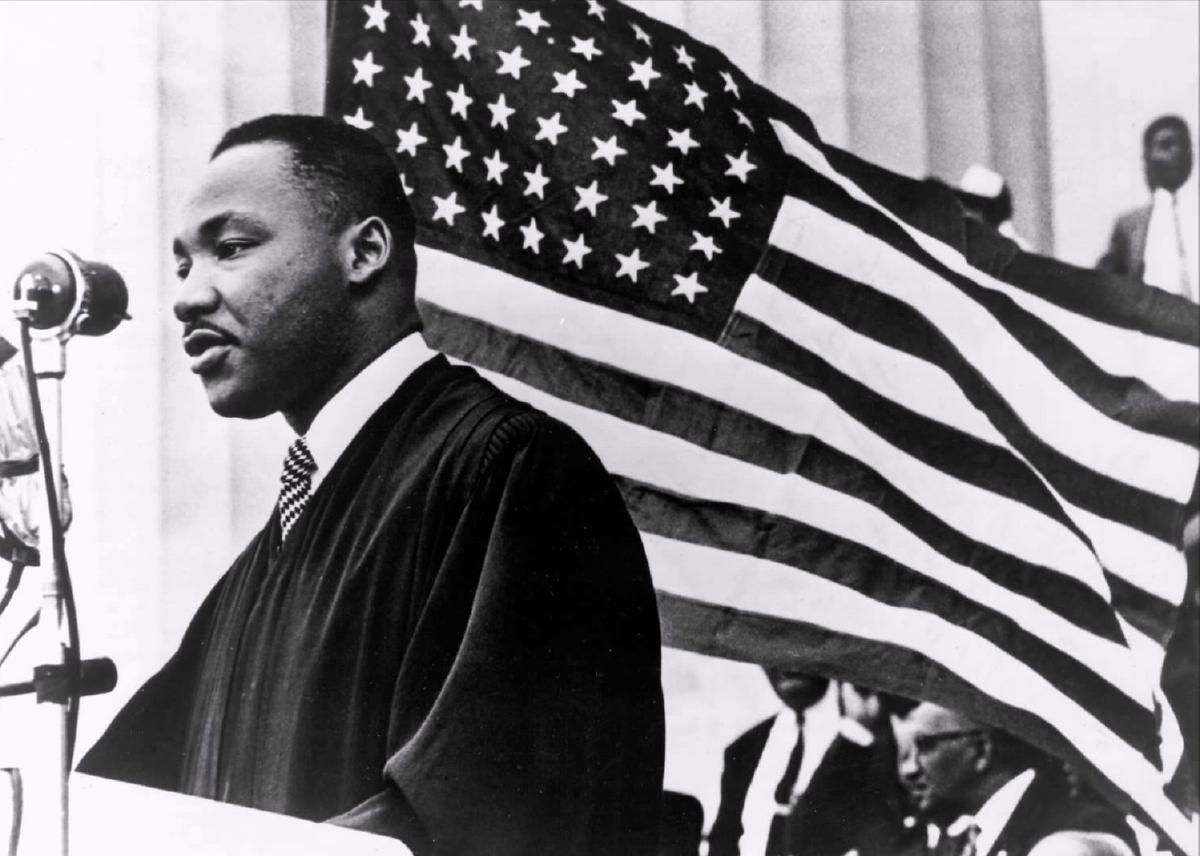

Every January, as the federal holiday commemorating the birthday of Martin Luther King, Jr. approaches, a years-old item that refers to the famous civil rights leader as "a phony, a cheater, a traitor, and a sexual degenerate" is circulated anew:
Four things you didn't know about Martin Luther King
1. His name wasn't Martin Luther. It was Michael. It was decided Martin Luther had a more prominent ring to it, so he went by that. He never legally changed his name. To this day, he lived and died as Michael King.
2. While working on his dissertation for his doctoral degree at Boston University, he heavily plagiarized from another author who had done research on a subject similar to King's. As academic committee later found that over half of King's work was plagiarized, yet would not revoke his doctrine. King was dead by this time, and the committee ruled that revoking the title would serve no purpose. It was also discovered that King's famous I HAVE A DREAM speech was also not his own. He stole it from a sermon by Archibald Carey, a popular black preacher in the 1950's.
3. King was under FBI surveillance for several years (until he died) due to his ties with communist organizations throughout the country. King accepted money from the organizations to fund his movements. In return, King had to appoint communist leaders to run certain districts of his SCLC (Southern Christian Leadership Conference), who then could project their communist ideas to larger audiences. A federal judge in the 60's ruled that the FBI files on King links to communism to remain top-secret until 2027. Senator Jesse Helms appealed to the Supreme Court in 1983 to release the files, so the correct bill in the Senate to create the Martin Luther King Federal Holiday could be abolished. He was denied.
4. One of King's closest friends, Rev. Ralph Abernathy, wrote a book in 1989 in which he talked about King's obsession with white prostitutes. King would often use church donations to have drunken sex parties, where he would hire two to three white prostitutes, occasionally beating them brutally. This has also been reported by the FBI agents who monitored King. King was married with four children.
Martin Luther King Day. A day when this country will come to a screeching halt so we can have parades and memorials to honor this man, a man that most of the world views as a saint for his role in the civil rights movement. No other public holiday in the United States honors a single individual. Of all the great leaders in our Nation's history-none of them have their own holiday. All of our great war heroes share Memorial Day. All of our great presidents share President's Day. Yet king — a man who was a phony, a cheater, a traitor, and a sexual degenerate gets a day of his own.
Unfortunately, most of this information is false and thereby misleadingly denigrates the memory of a man whom the U.S. has chosen to honor.
1) To this day, questions remain over the names of both Martin Luther King, Jr. and his father: what names they were given by their parents, what names appeared on their birth records, and when (if ever) they changed their names are subjects of some murkiness. According to an account Martin Luther King, Sr. gave to a New York Post reporter in 1957, he had always intended his son's name to be Martin Luther, and the appearance of the name 'Michael' in his son's birth records was a mistake due to confusion over his own name:
I had been known as Michael Luther King or "Mike" up until I was 22 ... when one day my father, James Albert King, told me: 'You aren't named Mike or Michael either. Your name is Martin Luther King. Your mother just called you Mike for short.' I was elated to know that I had really been named for the great leader of the Protestant Reformation, but there was no way of knowing if papa had made a mistake after all. Neither of my parents could read or write and they kept no record of Negro births in our backwoods county ... I gladly accepted Martin Luther King as my real name and when [my son] M.L. was born, I proudly named him Martin Luther King, Jr. But it was not until 1934, when I was seeking my first passport ... that I found out that Dr. Johnson, who delivered M.L., had listed him in the city records as Michael Luther King, Jr., because he thought that was my real name.
No records documenting a formal name change for either King yet have been uncovered, so in a strict legal sense one might say that Martin Luther King, Jr.'s name officially remained "Michael" until his death. However, what constitutes a "legal name" can be quite fluid. My own mother, born in the same era as Martin Luther King, Jr., was raised by people other than her birth parents from an early age and did not know her real first and middle names. (Indeed, she did not learn which names were actually listed on her birth record until I obtained a copy of the document for her when she was in her mid-50s.) Nonetheless, the first and middle names she adopted in place of the unknown real ones were listed on every government-issued record pertaining to her created during her adult lifetime (e.g., marriage license, driver's license, Social Security card, children's birth certificates) and were therefore her "legal" names every bit as much, if not moreso, than the ones that appeared on her birth record.
In any case, whether Martin Luther King, Sr. gave a true account of the issue in 1957 (i.e., that both he and his son were officially named 'Martin' by their fathers but called 'Michael' through confusion or mistake) or simply decided in his adulthood that he preferred he and his son be known as 'Martin' instead of 'Michael,' the name change was not, as suggested above, an affectation on the part of Martin Luther King, Jr.; it was something decided for him by his father while he was still very young.
2) This is the one claim presented here that has some element of truth to it. During the 1980s, archivists associated with The Martin Luther King Papers Project uncovered evidence that the dissertation King prepared for his Ph.D. in theology from Boston University, "A Comparison of the Conception of God in the Thinking of Paul Tillich and Henry Nelson Wieman," was plagiarized, and the story broke in the national media in 1990. King included in his dissertation a good deal of material taken verbatim from a variety of other sources without proper attribution (or any attribution at all), an act which constitutes plagiarism by ordinary academic standards.
The Martin Luther King Papers Project addressed the issue in Volume II of The Papers of Martin Luther King, Jr. (and reproduced a statement therefrom in the FAQ on their web site):
The readers of King's dissertation, L. Harold DeWolf and S. Paul Schilling, a professor of systematic theology who had recently arrived at Boston University, failed to notice King's problematic use of sources. After reading a draft of the dissertation, DeWolf criticized him for failing to make explicit "presuppositions and norms employed in the critical evaluation," but his comments were largely positive. He commended King for his handling of a "difficult" topic "with broad learning, impressive ability and convincing mastery of the works immediately involved." Schilling found two problems with King's citation practices while reading the draft, but dismissed these as anomalous and praised the dissertation in his Second Reader's report ...
As was true of King's other academic papers, the plagiaries in his dissertation escaped detection in his lifetime. His professors at Boston, like those at Crozer, saw King as an earnest and even gifted student who presented consistent, though evolving, theological identity in his essays, exams and classroom comments ... Although the extent of King's plagiaries suggest he knew that he was at least skirting academic norms, the extant documents offer no direct evidence in this matter. Thus he may have simply become convinced, on the basis of his grades at Crozer and Boston, that his papers were sufficiently competent to withstand critical scrutiny. Moreover, King's actions during his early adulthood indicate that he increasingly saw himself as a preacher appropriating theological scholarship rather than as an academic producing such scholarship ...
In 1991 a Boston University investigatory committee concluded that King had plagiarized portions of his doctoral dissertation but did not recommend the revocation of his degree:
A committee of scholars at Boston University concluded that Rev. Martin Luther King Jr. plagiarized portions of his doctoral dissertation, completed there in the 1950s.
BU provost Jon Westling accepted the panel's recommendation that a letter be attached to King's dissertation in the university library, noting that numerous passages lacked appropriate quotations and citations of sources. The letter was placed in the archives yesterday afternoon, a BU spokesman said.
Westling also accepted the committee's statement that "no thought should be given to the revocation of Dr. King's doctoral degree from Boston University" and the assertion that despite its flaws, the dissertation "makes an intelligent contribution to scholarship."
The investigatory committee, comprising three professors in the BU School of Theology and one from American University, was appointed by Westling after researchers at Stanford said they had discovered numerous instances of plagiarism in King's work as a graduate student.
While there was general agreement that King acted improperly, Clayborne Carson, head of the King Papers Project at Stanford where the plagiarism initially was uncovered, noted that King made no effort to conceal what he was doing, providing grounds for a belief that King was not willfully engaged in wrongdoing.
Westling said in a prepared statement yesterday that it was "impractical to reach, on the available evidence, any conclusions about Dr. King's reasons for failing to attribute some, but not all, of his sources. The committee's findings, although important from the point of view of historical accuracy, do not affect Dr. King's greatness, not do they change the fact that Dr. King made an unequalled contribution to the cause of justice and equal rights in this nation."
John H. Cartwright, a member of the committee and Martin Luther King Jr. Professor of Social Ethics at BU, said the committee had examined King's dissertation independently of the King Papers Project and "we did find serious improprieties."
The chair Cartwright occupies was created by the Boston University trustees after King's assassination. Cartwright was entering BU as a seminary student when King was finishing his doctorate.
"We had many of the same professors, we worked in the same atmosphere during our graduate studies," Cartwright said, and "under no circumstances would the atmosphere under which he did his work condone what Dr. King did. It's incredible. He was not unaware of the correct procedure. This wasn't just done out of ignorance."
The committee found that King "is responsible for knowingly misappropriating the borrowed materials that he failed to cite or to cite adequately." It found a pattern of appropriation of uncited material "that is a straightforward breach of academic norms and that constitutes plagiarism as commonly understood."
The letter to be attached to King's dissertation, Cartwright pointed out, "indicates there are serious improprieties and points readers to sources where they can find chapter and verse."
The committee found no grounds for charges raised last year that King drew his organization and chapter headings from another person's dissertation. The plagiarism, the panel said, was of passages from the works of philosophers whose concepts of God King was comparing in his work. The dissertation is titled "A Comparison of the Conceptions of God in the Thinking of Paul Tillich and Henry Nelson Wieman."
The committee also found no evidence that the professors reviewing King's dissertation had a double standard for African-American students and examined their work less critically than the work of whites. "Standards were applied with equal strictness to black as well as to white students," the panel concluded. "Black as well as white students failed out of the program."
Even though faculty supervision of King's work "failed to detect the large number of uncited borrowings that breached academic norms," the committee also found, the examining professors were not negligent "according to normal standards of supervision."
3) The claim that Martin Luther King "stole" his famous "I Have a Dream" speech from black pastor Archibald Carey is overblown. Carey's speech, a 1952 address to the Republican National Convention, and King's speech, delivered on the steps of the Lincoln Memorial in Washington, D.C., on 28 August 1963, are quite different; the only substantive similarity between them occurs in their perorations: both speeches end with a recitation of the first verse of Samuel Francis Smith's popular patriotic hymn "America" (composed in 1832) and references to several American geographic locations from which the speakers exhort their listeners to "let freedom ring":
[Carey, 1952]
We, Negro Americans, sing with all loyal Americans:
My country 'tis of thee,
Sweet land of liberty,
Of thee I sing.
Land where my fathers died,
Land of the Pilgrim's pride
From every mountainside
Let freedom ring!That's exactly what we mean — from every mountain side, let freedom ring. Not only from the Green Mountains and White Mountains of Vermont and New Hampshire; not only from the Catskills of New York; but from the Ozarks in Arkansas, from the Stone Mountain in Georgia, from the Blue Ridge Mountains of Virginia — let it ring not only for the minorities of the United States, but for ... the disinherited of all the earth — may the Republican Party, under God, from every mountainside, LET FREEDOM RING!
[King, 1963]
This will be the day when all of God's children will be able to sing with new meaning:
My country 'tis of thee,
Sweet land of liberty,
Of thee I sing.
Land where my fathers died,
Land of the Pilgrim's pride
From every mountainside
Let freedom ring!So let freedom ring from the prodigious hilltops of New Hampshire!
Let freedom ring from the mighty mountains of New York!
Let freedom ring from the heightening Alleghenies of Pennsylvania!
Let freedom ring from the snowcapped Rockies of Colorado!
Let freedom ring from the curvaceous peaks of California!
But not only that; let freedom ring from Stone Mountain of Georgia!
Let freedom ring from Lookout Mountain of Tennessee!
Let freedom ring from every hill and every molehill of Mississippi!
From every mountainside, let freedom ring!When we let freedom ring, when we let it ring from every village and every hamlet, from every state and every city, we will be able to speed up that day when all of God's children, black men and white men, Jews and Gentiles, Protestants and Catholics, will be able to join hands and sing in the words of the old Negro spiritual: "Free at last! Free at last! Thank God Almighty, we are free at last!"
4) J. Edgar Hoover's FBI considered Martin Luther King to be a threat to white America (terming him "the most dangerous Negro of the future in this Nation") and spent years trying to dig up and manufacture derogatory information about him in order to publicly discredit him and thereby neutralize his effectiveness as a civil rights leader. The FBI asserted that the Southern Christian Leadership Conference (SCLC) organization which King headed was controlled and funded by the Communist party and spent years trying to prove it, making King the target of an extensive surveillance program intended to gather evidence documenting ties between the SCLC and communists. But the Bureau was unable to uncover any credible evidence of active participation or funding between the Communist party and the SCLC, as David Garrow chronicled in his exhaustive study of Martin Luther King and the SCLC:
While King continued his criticism of the [Kennedy] administration, the Kennedys were in private consternation about FBI reports that American Communist party leaders were claiming that old ally Stanley Levison was the number one advisor to Martin Luther King. In fact, the reports said, word in the party had it that Levison was writing many of King's most important speeches. Though the FBI's informants had no dependable information that Levison was still loyal to the party's commands, they did know that he continued to give it modest financial support even after severing direct ties. The FBI suspected that Levison's 1955 departure from party activity might have been a cover, and that Levison's friendship with King might be a secret assignment undertaken at the behest of American Communists and their Soviet sponsors.
The FBI's assertions provoked fear in [Attorney General] Robert Kennedy and his closest assistants. Within several weeks time, two courses of action were decided upon. First, electronic surveillance of Levison would be instituted to monitor both his advice to King and any telephone contacts with Soviet or Communist agents. Second, those in the Kennedy administration who had some personal acquaintance with King all would warn the civil rights leader that he ought to end his relationship with Levison immediately. King would also be warned about Jack O'Dell, the man Levison had brought in manage the SCLC's New York office. O'Dell had been involved with the Communist party throughout the 1950s, and his public record of such associations could be used against King and SCLC.
On several occasions during the spring, Robert Kennedy and his assistants warned King about Levison and O'Dell, without being specific about the allegations. Each time the warnings were voiced to King, he listened quietly, thanked the speaker for his concern, and said that he was not one to question the motives of people in the movement, certainly not one so selfless as Stanley Levison. As King explained, how could he give credence to such vague allegations, coming from who knew where, when Levison had a proven track record of five years of honest counsel? If the administration had anything more specific to offer, King would gladly listen, but until then, he would not doubt one of his closest friends.
The FBI kept up its round-the-clock surveillance of Stanley Levison throughout the spring and summer. The wiretaps detected no contacts with Communist agents ... Though his ties to the party were now in the past, such evidence of his final disengagement did not persuade FBI officials, who continued to suspect that Stanley Levison might be a Soviet agent exerting substantial influence on the civil rights movement through his close friendship with Martin King.
Late in October serious controversy broke when several conservative newspapers ran almost identical front-page stories detailing the Communist party ties of SCLC staff member Jack O'Dell. The FBI-planted stories reported that the thirty-nine-year-old O'Dell not only had a public record of past association with the "CP," but in fact still served as a "concealed member" of the party's national committee. The Bureau hoped that this exposé would so embarrass King that the supposed Communist mole would be purged.
After several days, King issued a statement saying that O'Dell had resigned from the SCLC. While King's statement carefully noted that the SCLC had accepted the resignation, "pending further inquiry and clarification," those in the know, including the FBI, were aware that O'Dell remained with SCLC as head of its New York office. The FBI reasoned that King's deceptiveness in retaining O'Dell indicated that the civil rights leader was insensitive to the dangers of Communist subversion, as well as dishonest.
At King's request, O'Dell prepared a private letter explaining his political past. O'Dell stated in the letter that while he had previously supported the Communist party program, "quite awhile before" joining SCLC, he had concluded that his prior belief that "democratic reformation of the South ... required a Communist movement in the South" was incorrect and "mistaken ... I no longer hold such a viewpoint, and neither do I have any Communist affiliation," O'Dell told King. Satisfied with that statement, [attorney Clarence] Jones advised King that O'Dell's supposed "interim resignation" could be set aside, and that O'Dell could remain with SCLC because he "has no present communist affiliation whatsoever."
On the morning of June 30 [1963], the Birmingham News, relying upon information leaked by the FBI, revealed that Jack O'Dell was still on SCLC's payroll and working in its New York office despite King's claim that O'Dell had resigned. [Assistant Attorney General for Civil Rights] Burke Marshall again pressed King to cut all ties with O'Dell and Levison. Reluctantly, King gave in and acted on the first request. He wrote to O'Dell, in a letter primarily intended for Marshall's consumption, that the "temporary resignation" of the preceding November now was being made permanent. Although SCLC had not discovered "any present connections with the Communist party on your part," the continuing allegation that O'Dell was a secret member of the the CP's national committee was a damaging one, and "in these critical times we cannot afford to risk any such impressions."
Ralph Abernathy, who succeeded King as president of the SCLC after the latter's assassination in 1968, also disclaimed ties between the SCLC and the Communist party in his autobiography:
We assumed that, though filled with malice toward us, [FBI director J. Edgar Hoover] was a rational man who was merely misinformed about our ultimate aims. If we could disabuse him of his belief that we were Communists or else willing pawns of the international Communist conspiracy, perhaps he would call off his dogs.
The idea that we could reason with such people was naive. Nevertheless, at the time it seemed the best course of action to follow. So, while Martin kept an appointment in Baltimore, Andy Young and I flew to Washington to meet with Hoover's representative, Deke DeLoach, to see if we couldn't explain our aims and achieve some sort of truce.
It was a waste of time and money. DeLoach was not a man who could really speak for Hoover, and we spent most of our time trying to answer charges he was unwilling to admit the FBI had made. We assured him that Martin was not a Communist, that Communists did not control the SCLC and that we had no desire to tear down American society. We pointed out that even in the SCLC's constitution it states very clearly that "No member of this organization shall be a communist nor a communist sympathizer." All we wanted, we said, was equal protection under the law — the right to enjoy the full privileges of American citizenship.
Toward the end of the interview we realized that he was playing an elaborate and patronizing game with us, treating us with a strict courtesy that barely hid his contempt. We left more frustrated than when we had arrived. Not only would the FBI not cease and desist, they would not even talk to us about the matter.
Ralph David Abernathy did acknowledge in his 1989 autobiography, And the Walls Came Tumbling Down, that Martin Luther King engaged in extramarital affairs (evidence of which was sometimes recorded by the FBI through hotel room bugs), but he said absolutely nothing in his book about King's supposed "obsession with white prostitutes," King's using "church donations to have drunken sex parties," or King's hiring "white prostitutes and occasionally beating them brutally." In fact, Abernathy stated quite emphatically that he never knew King to have any sexual involvement with white women at all:
Much has been written in recent years about my friend's weakness for women. Had others not dealt with the matter in such detail, I might have avoided any commentary. Unfortunately, some of these commentators have told only the bare facts without suggesting the reasons why Martin might have indulged in such behavior. They have also left a false impression about the range of his activities.
Martin and I were away more often than we were at home; and while this was no excuse for extramarital relations, it was a reason. Some men are better able to bear such deprivations than others, though all of us in SCLC headquarters had our weak moments. We all understood and believed in the biblical prohibition against sex outside of marriage. It was just that he had a particularly difficult time with that temptation.
In addition to his personal vulnerability, he was also a man who attracted women, even when he didn't intend to, and attracted them in droves. Part of his appeal was his predominant role in the black community and part of it was personal. During the last ten years of his life, Martin Luther King was the most important black man in America. That fact alone endowed him with an aura of power and greatness that women found very appealing. He was a hero — the greatest hero of his age — and women are always attracted to a hero.
But he also had a personal charm that ingratiated him with members of the opposite sex. He was always gracious and courteous to women, whether they were attractive to him or not. He had perfect manners. He was well educated. He was warm and friendly. He could make them laugh. He was good company, something that cannot always be said of heroes. These qualities made him even more attractive in close proximity than he was at a distance.
Then, too, Martin's own love of women was apparent in ways that could not be easily pinpointed — but which women clearly sensed, even from afar. I remember on more than one occasion sitting on a stage and having Martin turn to me to say, "Do you see that woman giving me the eye, the one in the red dress?" I wouldn't be able to pick her out at such a distance, but already she had somehow conveyed to him her attraction and he in turn had responded to it. Later I would see them talking together, as if they had known one another forever. I was always a little bewildered at how strongly and unerringly this mutual attraction operated.
A recent biography has suggested without quite saying so that Martin had affairs with white women as well as black. Such a suggestion is without foundation. I can say with the greatest confidence that he was never attracted to white women and had nothing to do with them, despite the opportunities that may have presented themselves.
Of course, J. Edgar Hoover became preoccupied with Martin's private life early in the civil rights movement, and this preoccupation was a significant factor in Hoover's pathological hatred of him and the movement he headed. Early in the game the FBI began to bug our various hotel rooms, hoping to discover our strategy but also to gather evidence that could be used against Martin personally.
I remember in particular a stay at the Willard Hotel in Washington, where they not only put in audio receivers, but video equipment as well. Then, after collecting enough of this "evidence" to be useful, they began to distribute it to reporters, law officers, and other people in a position to hurt us. Finally, when no one would do Hoover's dirty work for him, someone in the FBI put together a tape of highly intimate moments and sent them to Martin. Unfortunately — and perhaps this was deliberate — [his wife] Coretta received the tape and played it first. But such accusations never seemed to touch her. She rose above all the petty attempts to damage their marriage by refusing to even entertain such thoughts.
A commonly circulated item about Martin Luther King that is not included in this list is the claim that King was a Republican. Such claims are based purely on speculation; King himself never expressed an affiliation with, nor endorsed candidates for, any political party, and his son, Martin Luther King III, said: "It is disingenuous to imply that my father was a Republican. He never endorsed any presidential candidate, and there is certainly no evidence that he ever even voted for a Republican."
As for the assertion that "no other public holiday in the United States honors a single individual" besides Martin Luther King Day, we note that Columbus Day (honoring explorer Christopher Columbus) is a federal holiday, as is George Washington's Birthday.